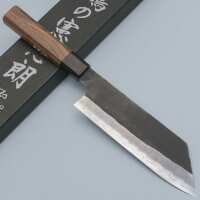
“I have this nice knife for 3 months now. It's the knife I use the most. First, the handle is a good choice: walnut is not as a delicate as magnolia wood (for instance), so you don't have to be as careful. Plus, the handle is quite thick, so it's good if you have bigger hands. Second, the blade profile is quite unique. The only knife that I'm aware of that has a similar profile would be a Hakata, but those are rare. With 51mm and the flat profile it's like a nakiri with a tip. I'd say it's quite "bulky" but that's practical. I use it for cutting vegetables and it works great. Sharpness out of the box was not as good as expected, but that's a minor detail given that it's easy to sharpen (I noticed while writing that the "bulkiness" also comes in handy in sharpening, plus you don't have to cover the handle with tape since it's quite dark and therefore less susceptible to discoloration). The kurouchi finish on my knive had some shiny dot-shaped spots but I don't mind and they are even visible in the video. So beauty is in the eye of the beholder and there are certainly fancier knives, but I think this is the perfect knive for me from a practical point of view.”
“I really like the knife because of the core steel Aogami Super (AS), the knife shape and the walnut handle. The sharpness out-of-the box was not so good, but because it's AS it's easy to sharpen. The shape of the knife is quite rare, most bunkas have a much more rounded blade profile. I use it for cutting vegetables, so the profile and the blade height (I also measured 51mm) are a advantages in my opinion. The only knives with a similar profile are by Shiro Kamo (not available anymore) or a Hakata by Hinoura. The handle is also nice and a bit bigger than most Japanese knives. Since it's walnut it is not as delicate as magnolia for instance. The overall look is rustic, which I like. There are two spots on the Karouchi finish, which you can also see in the video of the knife description, but I don't mind.”