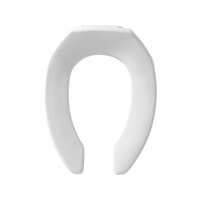
Facility managers rarely think about a toilet seat until it starts spinning sideways on its hinges. That single failure point loose mounting hardware drives more restroom service calls than any other fixture issue in high-traffic buildings. Church engineered its elongated open-front plastic toilet seat, MPN 295CT-000, specifically to eliminate that callback before it happens. This elongated open-front plastic toilet seat without cover mounts to elongated bowls in commercial restrooms using a self-securing hardware system that resists loosening under repeated use. Built from heavy-weight, injection-molded solid plastic in white, it pairs non-corroding stainless hardware with check hinges that stop the seat 11 degrees past vertical, protecting nearby flush valves and tanks. Facility teams specify this seat where restroom traffic is constant and maintenance visits are expensive. Solid Plastic Construction Engineered for Institutional Restroom Traffic The seat and ring are injection-molded from heavy-weight solid plastic, not the thinner shell-molded plastic found in typical residential seats. That construction choice matters in institutional settings, where restrooms see hundreds of daily uses instead of dozens. Solid plastic resists chipping, cracking, and surface staining better than lighter-gauge alternatives. Ring thickness measures 1-1/8 inches including the four molded-in bumpers, with a 13/16-inch ring section beneath them dimensions that give the seat rigidity under load without adding unnecessary bulk. The finish is molded-in white, meaning color runs through the plastic rather than sitting as a surface coating. Molded-in color doesn't peel, flake, or wear away the way painted or laminated finishes can after years of cleaning with institutional-strength disinfectants. Molded-In Bumpers and Ring Geometry: The Small Details Behind Seat Stability Four ring bumpers, molded directly into the plastic during manufacturing, sit at the underside contact points where the seat meets the bowl rim. Because they're part of the original mold rather than a bonded-on accessory, there's no adhesive layer to fail after repeated exposure to bowl condensation, cleaning solutions, or the flexing that happens every time someone sits down. Those bumpers do more than cushion contact. They keep the seat from sliding laterally across the bowl rim during use, a small but persistent annoyance in seats that lack this feature. In a facility restroom serving dozens of users daily, a seat that shifts even slightly generates far more complaint calls than most maintenance teams expect. Ring geometry plays a supporting role too. At 1-1/8 inches thick including the bumpers, the ring carries enough material depth to stay rigid under repeated load cycles without flexing or developing stress cracks near the hinge posts—a failure pattern more common in thinner residential-grade rings asked to perform outside their design intent. Plastic Versus Enameled Wood: Why Material Choice Drives This Seat's Category Toilet seat materials generally split into two families: molded plastic and enameled wood built over a particleboard or laminate core. Enameled wood seats can offer a heavier, more residential feel, but their surface finish is a coating rather than a material property chip that enamel layer and the underlying substrate is exposed to moisture, which shortens service life quickly in humid, high-use restrooms. Solid plastic construction avoids that failure mode entirely because the material itself, not a surface coating, provides the finish. There's no laminate edge to peel and no particleboard core to swell if water infiltrates a scratch or crack. That's a meaningful difference in restrooms cleaned multiple times daily with liquid disinfectants, where moisture exposure at the seat surface is constant rather than occasional. This is also why plastic dominates the commercial toilet parts category specifically, rather than the broader consumer seat market where enameled wood options remain common for their aesthetic appeal. Facility specifiers choosing between the two material families for public and institutional restrooms are generally choosing durability and moisture resistance over decorative finish options. Why Does the Open-Front, Less-Cover Design Matter for Public Restrooms? Public and institutional restrooms almost universally specify open-front seats without covers, and
Visit Product Page