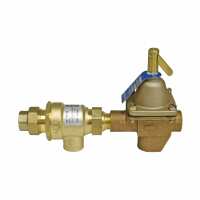
The Watts 386463 is a 1/2 inch bronze combination fill valve and backflow preventer built for hydronic boiler feed lines. It pairs a Model 1156F pressure regulator with a Model 9D dual check backflow preventer in one pre-assembled body, automatically adding make-up water between 10 and 25 psi while blocking reverse flow into the supply line, rated to 100 psi and 212°F. Every closed hydronic heating system loses a small amount of water over time through venting, minor seepage at fittings, and air separator purging. Without a way to replace that water automatically, pressure drops, pumps cavitate, and heat transfer suffers. The catch is that any pipe connecting a boiler to a water supply is a cross-connection, and if boiler-side pressure ever exceeds supply pressure, contaminated system water can push backward into the feed line. Plumbing Supply And More carries the Watts 386463 specifically because it closes both gaps in a single fitting instead of requiring a separate regulator and a separate check assembly. What's Actually Inside This Assembly: Model 9D & Model 1156F This assembly is not one part but two Watts components joined into a single bronze housing. The Model 1156F is the feed water pressure regulator; it senses boiler pressure and opens to add water only when pressure falls below its setpoint. The Model 9D is the backflow preventer; it sits on the downstream side and physically blocks water from traveling back toward the supply main. Because both components ship pre-assembled at the factory, there's no field assembly, alignment, or torque-to-spec step between the regulator and the check valve body. The union connections on either end are what installers actually work with during installation and future replacement. How the Dual Check Valve & Atmospheric Vent Stop Backflow The Model 9D uses two independent, spring-loaded check valves separated by a chamber that vents to the atmosphere. Under normal forward flow, both checks stay closed against their seats except when water is actively passing through to feed the boiler. If pressure on the boiler side ever rises above supply pressure, the checks seat tighter and the intermediate chamber opens to the atmosphere, physically breaking any path back into the potable or supply-side piping rather than just slowing it down. This two-check-plus-vent design is the same operating principle covered by the ASSE 1012 performance standard for backflow preventers with an intermediate atmospheric vent, which is what this style of device is tested against. What Pressure Range Does This Valve's Regulator Hold? The 1156F regulator inside this assembly has an adjustable range of 10 to 25 psi and ships factory-set at 15 psi. That factory setting matches typical residential and light commercial hydronic system fill pressure, so most installers leave it as-is unless the system's static height or expansion tank sizing calls for a different setpoint. A qualified technician can turn the adjustment screw to raise or lower the setpoint within that 10-25 psi window without replacing the valve, which matters for multi-story buildings where boiler elevation changes the pressure the system needs at fill. Is a Weeping Vent Port Normal or a Sign of Failure? A small amount of water at the vent opening during a fill cycle is part of how the Model 9D is designed to work, not automatically a defect. The intermediate chamber between the two checks is built to discharge to atmosphere whenever there's a pressure differential across the device, so a brief weep right as the system fills or right after a pressure spike is the vent doing its job. A continuous, steady drip with no fill cycle happening, or dripping that never stops between cycles, points to a worn primary check seat rather than normal venting. In that case the fix is replacing the internal 9D cartridge or check components rather than the regulator half of the assembly. Connections, Dimensions & Fit: NPT Union vs. Solder & Quick-Connect Options This model is the all-bronze union NPT x NPT
Visit Product Page