Login
Start Free Trial Are you a business? Click Here

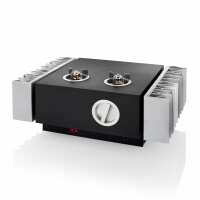
Pathos Classic Remix Tube Hybrid Integrated Amplifier Matte Metallic Black Reviews

4.8 Rating 5 Reviews
Read Upscale Audio Reviews
Visit Product Page

Phone:

909.931.9686

Email:

joel.m@upscaleaudio.com

Location:

2058 Wright Avenue,
2058 Wright Avenue
California
91750

George Anderson
Verified Reviewer
I'm now about 300 hours into playing LPs and mainly CDs through the Pathos Remix. I did not buy the additional DAC option as I already have a Bel Canto 3.7 DAC. Other system components include a Schitt Mani phono pre-amp, and PS Audio PerfectWave DirectStream Memory Player as my CD transport and my speakers are Sonus Faber Sonetto VIII with a frequency response of 36 Hz – 25.000 Hz, sensitivity of 90 dB SPL (2.83 V/1m) and nominal impedance 4 ohms. An important point to consider in this review is that I replaced the supplied Electro-Harmonix pre-amp tubes with a matched pair of NOS Amperex E88CC Bugle Boys. (Being into tube amps tube rolling is always a factor!) I would add you don't need to change the pre-amp tubes. My previous system amplifier was a Willsenton R8 all-tube amp using KT88s for output. I’ve added system components to this review as synergy is a factor in explaining my impressions of the Pathos Remix's performance, and those are also based on the results of using well-mastered CDs as a source: Music Detail and Definition Excellent fine musical instrument detail without becoming high-end HiFi over-detailed or analytical. You can critically and leisurely listen and I'd describe the Remix as being a neutral if slightly warm and rounded reproducer of musical. Its detail level will reveal harsh, bright and compressed recordings but always they remain toe-tapping listenable. I do not get tired and always want to listen more over extended periods (something I didn’t do with the previous amp). Remix Sound Versus Tube Amplifier The Remix gives a lot of the tubey space and air but with lots more definition and authority (what I was looking for) across the entire frequency range. Bass isolation, definition and reproduction are all very good. Sound staging is accurate as per the recording. The depth of the soundstage is also very good. Instruments are clearly defined and placed and particularly with well-recorded material you can get the sense of the music being realistically in the room with you. I Like And Would Recommend The Remix I have zero buyer's remorse in choosing the Pathos Remix it is finely constructed and does a great job of being a very listenable and entertaining analog amplifier that is a joy to use. It works well with all the genres of music I listen to (which is most genres) both on old and new recordings and is a solid all-round performer. Also, I should mention I have used the headphone output with Sennheiser 650s and the sound is great from that source too. Audition this amplifier as it performs excellently even if it is from a less well-known Hi-Fi brand and was originally released in 2014 with upgrades made to the DAC more recently. It does give you the best of both worlds which is precisely what a hybrid amplifier should do!
8 Helpful Report
Posted 3 years ago
Mark Stamper
Verified Reviewer
Author didn't leave any comments.
Helpful Report
Posted 3 years ago
Jeff Bellin (AnalogJ)
Unverified Reviewer
The Pathos Classic Remix is a really fine product, doing some things very well, and a few things extraordinarily well. But I am giving it 4 rather than 5 stars for a couple of reasons, which may or may not relate to your situation. First of all, this sort-of jack of all trades product is great in that it does a lot of things well in a compact unit. I haven't tried the digital capabilities, as I'm not really using this for that. I can always get an external digital processor, and there are plenty of inputs to add that later. But if you want their internal one, that's an extra charge and I read that it is really good. It has an included headphone amp, utililzing the tubed preamp circuit. It's an excellent match for my Grado 325is. It will allow me to sell my Schitt Mani standalone headphone amp. At only a couple hundred dollars over the Classic One, I thought that the Classic Remix was worth the extra money and would be a smart purchase. I set out to replace a souped-up Unison Research Unico, which I had modified by Chris Johnson up at the Parts ConneXion in Canada. I loved what the modifications did, but 18 years after purchasing the Unico and having it modified, it died. The US-based tech couldn't fix it. So I did sell it for parts, and set out to replace it. Without a current strong US representation, I wasn't sure I'd want to buy another Unico, as much as I really liked the sound, but I did really like the idea of a hybrid. I had heard the Conor 1.10 fully tubed integrated with my speakers, and the match was astounding. Full-bodied, full-blooded, it fully engaged my speakers, and recreated absolutely (virtually, of course) tactile, 3-dimensional images. But at ~$6500 and being a very warm running amp, it would not be a good fit for my pocketbook or my small listening space. Alas, there weren't great hybrid options at hifi emporiums in the eastern New England area within my budget. I did try a McIntosh 252 integrated, but I found it thin and a bit sterile. So with a bit of trepidation due to that it I'd be on the hook for shipping costs back across the US if I didn't like it, I tried the Pathos Classic Remix, although I considered the Classic One. I contacted Pathos to ask about the differences between the two. Those whom I spoke to at UA didn't really have a whole lot of hands-on experience with regard to the lower end of the Pathos line. They all love the higher-end models, but didn't have close experience with the lower-end models. The rep from Pathos told me that, while the Classic Remix was based on the Classic One, changes were made internally to incorporate the tube section in the preamp stage more in the sound than the Classic One, making it sound more tubey. What I also noticed is that the s/n ratio of the Classic One was >90dB while the Classic Remix's s/n is >100dB. The latter's spec in that department is quite a bit better. And let me tell you, the Remix is QUIET. I am hearing the smallest, slightest musical impulse, such as the slightest touch of a brush on a snare and even how it was brushed, the preparation of a singer about to sing, and even the slightest change in volume and space when moving in front of a microphone. The tiniest of impulses are conveyed here, which makes balladic and small-scale musical material incredibly compelling. I never got that sort of small-scale musical impulse from the Unico. At times, it's really astonishing. I really get pulled into the littlest things in the performance. On larger scale stuff, there's plenty of power here, as there's tons of current delivery with this amp. Large-scale bursts are handled easily without getting confused, and transients are very, very good. No complaints. Is this THE last word in pace, though? No. You might get more with a fully solid-state design, perhaps, or even more sensitive speakers than mine (87dB). The one area where it's not top-notch is the rhythmic grip at the low end. It's not the tautest, leanest bottom end. It's not bad, but it doesn't rhythmically grip with an iron fist either, so the snap and weight of an acoustic bass in the jazz group doesn't quite propel the music as much as I'd like (and as much as I heard through the Unico). But there's so much else to love here. That humanity of the smallest-scale impulses which I talked about above can be quite magical. The swell and burst of larger dynamics when needed are very exciting and welcome, not just having the music get louder, but swell in physical volume as well, getting expansive (although, again, I was spoiled by the Conor 1.10, as its ability in that department floored me. I mean performers in front of me were recreated in flesh and blood if I closed my eyes.). The ease and liquidity of the music are here in spades, and that's how music should be. The images are fairly rich and saturated in a way the McIntosh 252 were not. All types of music I listen to, including jazz and classical, come through well here. Even rock and roll does gets quite well-served here, as it remains clear when loud, and dynamics are quite quick in the midrange and top end. So I have taken off 1 star for a couple of things - its lack of great solid grip in the bottom end, for one. And the second thing is the tubes that come with it. The Russian Tung-Sols started off quite bright, and really tubby in the bottom end. The midrange was fine, but overall the sound wasn't balanced. It irritated me. While I was appreciating the amp's ability to convey those wonderful little human musical impulses, I wasn't happy with its balance, and particularly with the bottom-end tubbiness. Joel at UA urged me to keep breaking it in, and UA even gave me extra time with amp. And while some of the top end brightness tamped down (not completely), the bottom end remained somewhat tubby. I was thnking that it might have been a slight mismatch with my loudspeakers, but I was getting the same issue through my Grado 325is headphones, ones absolutely not known for their loose bottom end. Talking with another pro in the audio business, we came to the conclusion that the issue wasn't with the amplifier section, but with the preamplifier section, specifically with the tubes. Well, since I was still in the trial period, I really needed to find some other tubes to try; and UA doesn't offer a trial period with their tubes (a few other sites so). I did purchase a pair of NOS 1960s tubes to try which were reported to be a more neutral tube than the Russian Tung-Sols (although, apparently, they shouldn't be confused with NOS Tung-Sols, non-Russian-made ones, which are reported to be really good). Well, the NOS tubes proved to be a MUCH better match with the Classic Remix. It tightened up the bass (although it's still not absolutely rock-solid), and rendered a much more natural top end, while retaining, in fact, allowing more space to the midrange. So my guess is you're going to need to budget in some tube-rolling with this amp. And ECC88/6DJ8 tubes aren't the most common type of preamp tube, either. Not impossible to find. They're out there. Just a bit less common. I'd suggest if you find ones you really like with this amp in your situation, you might want to get an extra pair. Preamp tubes last for many thousands of hours anyway, so it will be a while before you'll need to replace them, but know that if you're experiencing an imbalanced tonality with this amp, it's the tubes. Overall, I really, really like this amp a lot, even though it doesn't have the greatest bottom end grip. That's the one area I wish were a bit better. It's with jazz where the bass really helps drive the music, and I'm not getting that quality as much as I'd prefer. But this amp is otherwise SO expressive and musical. Some people might think that spending this sort of money on an integrated amp is crazy, but you have to hear it for yourself, the sort of extra musicality and involving qualities this sort of thing brings out. Again, it brings me back to the twice-as-expensive Conor 1.10 and the jaw-dropping things that it's capable of. This isn't up to that level in all areas, but at half the price, it does some things really satisfyingly well. And that it offers a really excellent headphone amp (and digital capability) as part of the package, it's really an excellent value. Regarding the looks, well, for sure, it's not to everyone's liking. This is something out of MOMA - Bauhaus or Brutalist-style of architecture. It ain't the wannabe old tube classic amp style of the Classic One. I got the basic rough-black finish. I wish it weren't another $400 to get the fancier finishes, because those are far-out. If you have the extra budget, and know that you'll have this in the long run, perhaps you'll want one of the fancy finishes, such as the Ferrari red. By the way, if this is a concern, some of UA's stock might have been sitting in their warehouse for a while. I got my Classic Remix in January of this year, 2022, but the unit was actually manufactured in 2019. If that bothers you, then you might want to ask about the unit they're going to send you. The solid block of aluminum remote included is substantial feeling, and controls volume, on/off, input selection, and mute. There are engraved symbols to help you discern which is which. The manual is very basic, nothing at all fancy (I'm actually a bit surprised that it didn't reflect Italian design. Instead, just basic printing onto folded plain paper.. Not a lot of information, but enough to get you started. In contrast, the Unison Research Unico's manual came bound in wood.
8 Helpful Report
Posted 3 years ago
Awesome product. End game for me.
2 Helpful Report
Posted 3 years ago
Author didn't leave any comments.
Helpful Report
Posted 4 years ago