Login
Start Free Trial Are you a business? Click Here

Dried Mealworms Reviews

4.9 Rating 539 Reviews
Read Vine House Farm Reviews

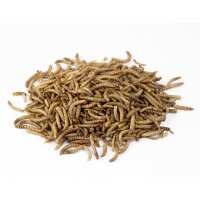
Our Dried Mealworms are a great source of protein and have been a real hit since we first introduced them. Dried mealworms have a similar level of fat and protein as the live equivalent.
What birds enjoy eating Dried Mealworms?
Dried mealworms will be eaten by most soft bill species and in particular Robins, Starlings and Blackbirds. House Sparrows will also eat them. 
How do I feed Dried Mealworms to birds? 
Dried Mealworms can be fed on their own, in a mealworm feeder or can be added to seed mixes. It’s very important that Dried Mealworms are soaked in water prior to feeding in the breeding season, as it is also the moisture that the young nestlings require. 
How should I store dried mealworms?
They should be stored in a dry cool place.

Visit Product Page
Sharron Courtney
Verified Reviewer
“The birds in my garden absolutely love the mealworm there is always a mad scrum for them as soon as I put them out”
Helpful Report
Posted 2 years ago
Frances Weir
Verified Reviewer
Author didn't leave any comments.
Helpful Report
Posted 2 years ago
Patricia Bates
Verified Reviewer
“I soak them in warm water for a few minutes and the birds love them”
Helpful Report
Posted 2 years ago
Graham Moore
Verified Reviewer
“Always receive a good quality product from this company”
Helpful Report
Posted 2 years ago
Robin Gibson
Verified Reviewer
“item received quickly, well packed and in good condition”
Helpful Report
Posted 2 years ago
Anne Addison
Verified Reviewer
“Gone in a flash ! Every bird likes these. One observation, they are so expensive. They had better reduce in price when we humans start to eat them”
Helpful Report
Posted 2 years ago
“Well packed, high quality product. Very fresh and a good size.”
Helpful Report
Posted 2 years ago
“I'd prefer to give the birds live mealworms - but they are expensive. These still go down well and I mix them up with seeds and suet pellets. Sometimes I also soak them in water first.”
Helpful Report
Posted 2 years ago