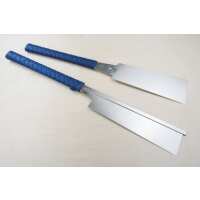
Set includes: Gyokucho 373 professional dozuki 240mm is a smooth, accurate saw with a very thin plate and a full length spine perfect for fine joinery, trimming components to final length, defining the shoulders of half laps and housings etc.
Gyokucho Bluehard Ryoba 210mm is a highly controllable saw for precise and careful work. Rip teeth on one edge, crosscut on the other, ideal for tenons, lap and bridle joints. A slightly shallower angle on the toothline makes this less aggressive than a standard ryoba with a sawplate that is heat treated to be a little stiffer. Please note, this saw was originally intended for the Japanese domestic market so all the packaging is in Japanese.
Dozuki specifications:
Blade length: 240mm
Overall length: 550mm
Blade thickness: 0.3mm
Pitch: 1mm / 25.4tpi
Set: 0.125mm per side
Max depth of cut: = 45mm
TPE handle
Replacement blade = Part No S-370 (371 and 372 will also fit this saw)
Ryoba specifications:
Blade length: 210mm
Blade Depth: 70 - 87mm
Overall length: 530mm
Blade thickness: 0.45mm
Pitch XC: 1.5mm / 16.9tpi
Pitch Rip: 3.7 - 2.5mm / 6.9 - 10.2tpi
Set: 0.125mm
Max depth of cut: ∞
TPE handle
Replacement blade = Part No S-649 (S650, S651, S655 will also fit this saw)
Gyokucho razorsaws, the original replaceable blade Japanese saws, have long been renowned for their cutting efficiency and excellent durability. The latest generation of Gyokucho saws have blue handles made from TPE (thermoplastic elastomer) a remarkable material that is simultaneously hard and resilient yet feels velvety to the touch and affords a superb grip. Rest assured that TPE is an eco-friendly alternative to rubber, and isn't harmful to the environment as it is completely recyclable.
The blades of Gyokucho saws are treated using a process called electroless nickel plating, this has three functions. Firstly, it protects the blade against corrosion, secondly it provides a nice shiny mirror surface so you can gauge your cutting angles, and thirdly its low friction properties inhibit resins and sap from building up on the blade - anything that does manage to get stuck to them can easily be washed off with warm soapy water. The teeth are differentially impulse hardened, one by one, bringing the outer surfaces to RC68 or more whilst still leaving the 'root' of the tooth soft and therefore much less prone to fracture - not unlike tiny Japanese sword blades. They are equally happy working in softwoods or temperate hard woods and can, with care and a light touch, be used on exotic timbers too.