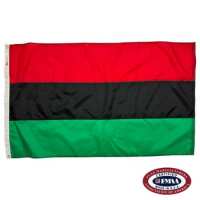
Celebrate all African peoples and their descendants with our Pan African flags. This historic design symbolizes unity among African people across the continent and throughout the global diaspora.
Our Pan African flag is made in the United States from durable, fray-resistant nylon. Lightweight and quick-drying, nylon allows the flag to fly easily in mild winds and recover quickly after rain. The red, black, and green design is digitally printed using UV-resistant inks to deliver bold, rich colors that resist fading from sun exposure.
Finished with a sturdy canvas header and brass grommets, the Pan-African flag attaches easily to any of our outdoor flagpoles. The 3’ x 5’ size is our most popular option and pairs especially well with a 6’ house-mounted tangle-free flagpole.
Pan African Flag Features
Made in America
Authentic 1920 design
100% pure nylon
Sturdy canvas header
Brass grommets for reliable mounting
Are you planning on displaying this flag indoors? Consider using a Pan Africa flag with gold fringe and a pole sleeve instead.
Pan African Flag Meaning & History
The Pan-African flag was first adopted on August 13, 1920, by the Universal Negro Improvement Association and African Communities League (UNIA-ACL), a group dedicated to improving the lives of African and African-descended people worldwide. The design was created by Marcus Garvey, founder of the UNIA-ACL, who was born in Jamaica and lived in the US for over a decade. For these reasons, the flag is also often referred to as the “Marcus Garvey flag” or the “UNIA flag.”
Today, the Pan-African flag is a widely recognized symbol of Black solidarity and unity. Each color has a specific meaning: red represents the bloodshed in the quest for Black liberation, black symbolizes the people the flag is meant to represent, and green stands for the vegetation and natural resources of the African continent.
The design of this flag has inspired several African nations to create similar national symbols, often using the same colors. In addition to the African diaspora abroad, the countries that fall within Pan-Africanism include:
Algeria
Guinea
Sierra Leone
Angola
Guinea Bissau
Somalia
Benin
Kenya
South Africa
Botswana
Lesotho
Sudan
Burkina Faso
Liberia
Swaziland
Burundi
Libya
Tanzania
Cameroon
Madagascar
Togo
Cape Verde
Malawi
Tunisia
Central African Republic
Mali
Uganda
Chad
Mauritania
Zambia
Congo
Mauritius
Zimbabwe
Djibouti
Mozambique
Egypt
Namibia
Equatorial Guinea
Niger
Ethiopia
Nigeria
Gabon
Rwanda
The Gambia
Sahrawi Republic
Ghana
Senegal