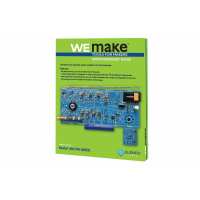
“Absolutely fun! Super fast easy! I’d recommend this to anyone, easy to read instructions,One thing the packages were not label. Had to hunt for parts. Oh and it was missing one of the germanium diodes. Thank goodness I had one to put in. I’d like to make it more powerful, I’ll have to do some research. I also added a solar panel. With a rechargeable battier. With a step down and a fuse. Wish it came with a case.. I’ll most defiantly buy a couple more as gifts.”
“This kit is awesome. Very good quality. The parts are grouped according to their functionality. The manual is good (good font type and size). It brings, besides explanation, some exercises to be solved as long as you assemble the radio. It is very well structured and has lots of pictures.It could bring more about radio theory.I'm very satisfied with this kit.”
“Enjoyed putting this kit together. I like it because it uses discrete components for the radio receivers. It comes with all the transformers and tuning capacitor which would be hard to find to build one from scratch. I was interested in how a superheterodyne receiver works. The kit was built without using test equipment, just doing the manual adjustments by ear at the end. Basically, if all the components are installed correctly in the right place with good solder connections, the radio should work. It needs the manual adjustments to make it work as well as it can. To get the lower frequency FM stations to tune in, the procedure in the manual showed that more inductance was needed on coil L3, even though the coil was compressed as far as possible. I had to make a new coil with about twice the inductance of the one that came with the kit to get them to tune in. A better external FM antenna improves reception. Some minor issues I had with the kit: When the tuning knob's retaining screw is tightened it binds the knob against the board so it's hard to turn. The knob needed to be modified so there was clearance.When the battery was removed from the holder, one of the holder's contacts pulled off the holder still clipped to the battery. The holder had to be repaired to reattach the contact. If the optional transistoraudio amplifier board is plugged into the 8 pin dip socket, it will distort the socket's contacts so they will no longer grip the LM386 if changed back to it. To use the kit as a normal radio I built a case for it and attached a 4 in. speaker. Surprisingly, the LM386 drives the speaker loud enough for normal listening. To power the radio without the battery, I used a 12 volt DC wall adapter regulated down to 9 volts with a LM317 ripple rejecting regulator. Just using a 9 volt DC wall adapter introduced noise, so the regulator had to be used.”
“This is much more than just a soldering exercise! The instruction booklet is more of a courselet in that it teaches the how and why along with the how to. Impressive little thingie.”