Login
Start Free Trial Are you a business? Click Here

Sashikomi Polishing Ko-Choji Katana Reviews

4.3 Rating 4 Reviews
Read Swordis Reviews

About Swordis:

Swordis, an online retail store, specializes in a wide array of swords, showcasing selections from some of the most esteemed brands in the industry. This emerging startup has expanded its scope by incorporating SwordEncyclopedia, a blog known for its extensive sword resources and recognized as a leading authority in this niche. Swordis' shop section offers an impressive range of over 1000 products in various categories. Their collection not only includes Japanese swords, Historical European Swords, and Military swords, but also extends to specialized items such as Technical knives, machetes, and a fascinating variety of fantasy swords and more. Featuring 19 distinguished brands, Swordis caters to a diverse clientele, ranging from historical enthusiasts to imaginative collectors.

Visit Product Page
How's the Blade?
How are the Handle and Fittings?
The sword is ok i dont know if it's just my sword but the Ko-choji hamon isn't as profound as I thought it would be looking at another person review with a photo I wish my blade looked like the one they got. Then when you spend $700 on a sword the habaki and seppa shouldn't be lose. Swordis did help by telling me how to fix it but still shouldn't have to go threw that and I had to spend more money so I had the tools to fix it. I was gonna buy Z-SEY Nami Koshirae Wakizashi to match my katana but after this, it's unlikely ill take that risk
Helpful Report
Posted 4 months ago
We apologize if you were disappointed. Please note that all swords and polish levels are the same across all of our products. Regarding loose habaki or seppa, Shadow Dance swords are assembled using a single mekugi pin that is drilled at an angle. During transportation, this pin can occasionally become damaged or crushed. For this reason, we include spare mekugi pins so you can easily replace the original and resolve the issue. No special tools are required to remove the pin—only a small stick and a hammer, or any hard object that can serve as a substitute for a hammer. For example, an Apple charger can be used to gently tap the pin out. This is a common risk with any Japanese sword. However, one of the advantages of Japanese swords is that they are designed to be disassembled. In fact, when ordering traditional Japanese swords, they are often shipped disassembled and can be fully assembled in less than two minutes. The same applies to replacing a mekugi pin, which typically takes no more than two minutes.
Posted 4 months ago
How's the Blade?
How are the Handle and Fittings?
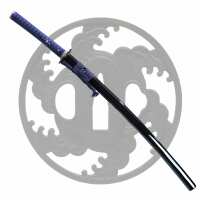
I have a Naval background so I jumped at the opportunity to acquire a Nautical themed Katana. I was drawn to the deep, sea blue of the Ito against the black Samegawa. The Tsuba has a wave pattern that carries over to the wave theme of the Fuchi, Menuki and Kashira. My computer/monitor showed the color of the Ito to look more purple than blue, but I confirmed it was blue and as stated, I wasn't disappointed. The Fuchi and Kashira don't have a brass appearance, rather a very attractive antiqued cupro-nickel. The Menuki is a brighter, shinier cupro-nickel and they flow together with the iron Tsuba. I prefer iron to brass anyway and like I said, there is a flow from the subdued cupro-nickel of the fittings to the grey iron, with copper Seppa and Habaki instead of the more common brass. The Ito is tight with symmetrical knots that are very tight and no movement anywhere. The blade is beautiful with an attractive Hamon and very clean lines. I have one complaint in that the Habaki is loose in all dimensions with movement and rattling. I am also disappointed with the fit in the Saya as the blade is loose and binds when sheathing the sword and it requires some manipulation when reaching the Habaki. Finally, there was some damage to the Kojiri. This was odd as the sword was very well packed in the box and I can only conclude that the damage occurred before or during the packing and not during shipment.
1 Helpful Report
Posted 8 months ago
Regarding assembly, Shadow Dance swords are assembled using a single mekugi pin that is drilled at an angle. During transportation, this pin can rarely become damaged or crushed. For this reason, we include spare mekugi pins so you can easily replace the original and resolve the issue. One of the advantages of traditional Japanese swords is that they are designed to be disassembled. In fact, traditional Japanese swords are often shipped disassembled and can be fully assembled in less than two minutes. The same applies to replacing a mekugi pin, which typically takes no more than two minutes. Regarding looseness of the saya, this can occur due to climate changes, as the wood may expand or contract. We can provide instructions on how to address this issue if needed. However, if the koiguchi is damaged, this is considered a defect, and we will send you a replacement saya.
Posted 4 months ago
How's the Blade?
How are the Handle and Fittings?
Just an all around amazing sword. The blade is gorgeous with the ko-choji hamon. The silk tsumamimaki is EXTREMELY tight. Easily up there with my Japanese made iaito. Shadow Dancer has shown again why they are the top sword makers in China.
Helpful Report
Posted 1 year ago
How's the Blade?
How are the Handle and Fittings?
This is my first purchase from Swordis and Shadow Dancer. Elegant and beautiful, the hamon is mindblowing. It is easily the best looking sword in my collection. In my hands, it feels like a high quality sword, fittings and ito are tight, will update my review after cutting practice
1 Helpful Report
Posted 1 year ago