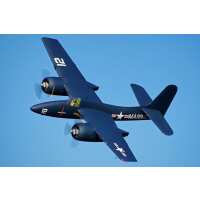
“FlightLineRC F7F-3 Tigercat: Being a long time Tigercat enthusiast I could hardly wait for this new model. The promotional photo's and video were enough to make me really want this one but having it in my hands was exciting. I loved it so much I purchased a second one to repaint into a Firecat aerial tanker. Fit and finish on this model has raised the bar on what foam models are becoming. It is really nice. The design to make the wings easily removable for limited transport or storage space is well thought out and goes together and apart quickly and easily. With the tricycle landing gear, ground handling is as easy as it gets. Fairly large wheels for its size make it easy to operate on moderately rough terrain. The best part is its flying qualities. I would not hesitate to recommend this model to an intermediate flyer or even an advanced beginner. It has very excellent slow speed handling for its weight. Some have complained of its lack of power climbs and speed but I think it's more than adequate and I am very satisfied with its performance. I have zippy fast models both prop and EDF if I want to get my adrenaline going. The only negative I ran into was during assembly the flap pushrods were almost too short with the servo arms default index. Without pulling and re-indexing the servo arms I had to adjust my servos through the radio to their maximum and the pushrods were still almost too short. They should easily be at least 5-10mm longer but I did get them to adjust acceptably. From a purely scale point of view the main landing gear are a little spindly in appearance but functionally are good. The nose gear looks very scale. MotionRC offers aftermarket spring compression landing gear for those that operate off of REALLY rough terrain. Overall I'd give this model 4.8 out of 5 stars and would highly recommend this model to anyone.”
“I ordered my Tigercat on a monday and it arrived here in Arizona onfriday. I put it together that night without a hitch and flew it Sunday afternoon. The plane is exactly as advertised. It is incredibly smooth and stable, has excellent details that makes it one of the prettiest birds on the flightline. This was my first plane from Motion RC, it will not be the last.”
“Size, scale and performance, what else can a guy ask for? To be honest, I wasn't sure if I would like how this plane performed. I've been flying EDF jets for some time now. The speed and Ferrari looks makes my heart pound. Along the way, I cut my teeth on many warbirds. The nostalgia drew me in and their beauty kept me intrigued. The Flightline Tigercat was another offering that reminded me of the passion I have for all military flying things. No, it's not a jet. However, I thought that it might be fun to tool around the skies with the F7F. Holy cow! I didn't realize how sporty and fun this propeller driven vixen would be! Its very efficient motors lay down impressive flybys at 60% throttle, while keeping battery consumption to a minimum. Point it and watch it go! Aerobatics are made easy. I have yet to find myself in a position of needing 100% power. Landings? Are you kidding me? I don't think I can set the airplane on the ground any softer with my own hands than it lands with the help of a radio. I feel like I'm cheating. Well done MotionRC, Flightline and Grumman! This one is a home run. I can't think of anything to suggest, other than order one today.”
“The plane went together as perfect as possible with no problems. The first test flight was rock solid with only MINOR trim change. I was VERY impressed!COMMENT: MotionRC; according to my limited research no F7F-3's were delivered with counter rotation props AND if they were, the props would have been rotating opposite of the MotionRC out-of-the box motors. The rotation to allow P-Factor (not BTW torque) to counter the asymmetric thrust should be right engine counter clockwise and left clockwise as viewed from the cockpit. The P-factor results from the downward moving blade having a larger prop angle of attack to the relative wind than the upward moving blade, in a higher than normal angle of attack, such as when climbing OR single engine straight & level. SE requires rudder into the live engine and a slight roll into the live engine. (5000 hours CFI time teaching civilian pilots). The P-38 had such counter rotating props but was changed to the exact opposite rotation because it produced a more stable gun platform. I presume that was a finding of better air flow over the twin rudder on the P-38 which were on the small size.. BTW, the F7F in early development was found to require a larger rudder to counter among other issues the asymmetric thrust in engine-out situations.”